






Technology
Batteries and charging
Two things decide what living with an electric or plug-in hybrid BYD is like: the battery it carries, and the time it spends on a charger. Both are explained below, model by model.
The Blade Battery
One battery, under the whole range
Every BYD electric car and every DM-i plug-in hybrid runs on the same battery: the Blade Battery, a lithium iron phosphate (LFP) pack BYD develops and builds itself. Instead of small cells packed into modules, it uses long, flat blade-shaped cells in a honeycomb structure; in cell-to-body versions the pack becomes part of the car's structure, doubling body rigidity and lowering the centre of gravity. The safety case rests on the nail penetration test: a steel nail driven through a fully charged pack, standing in for metal reaching the battery in a crash. The Blade Battery gave off no smoke, did not catch fire, and its surface stayed between 30°C and 60°C. Nickel-cobalt-manganese (NCM) cells can enter thermal runaway above 200°C and release oxygen, which is what feeds a battery fire. LFP releases none.
- 5,000+charge cycles
- 0smoke or flames in the nail test
- 30-60°Csurface temperature in that test
- 50%more space-efficient than a modular pack

What it means for the owner
Why the pack is built this way
The layout is not only a safety story. It also decides how long the battery lasts, how much room is left for people, and how the car handles heat and cold.




Charging
AC and DC do two different jobs
AC charging - a domestic socket, a home wallbox, a public AC post - sends alternating current to the car, and the on-board charger converts it before it reaches the battery. That conversion sets the ceiling, so AC charging is counted in hours. It is the charge you leave running while the car is parked, and one night covers more than an average day. DC fast charging skips the on-board charger and feeds direct current straight to the pack, so it is counted in minutes - the charge you take on a trip, while you have a coffee. Those figures are quoted over a partial window, typically about 30% to 80%, not from empty to full. The battery management system, one of the eight units in BYD's 8-in-1 electric drive, governs current and temperature.
In practice
Four ways you will actually charge
- A normal household socketAn electric car charges from a standard domestic socket. It is much the slowest method, so it suits topping up overnight rather than refilling an empty battery.
- A home wallbox, overnightA wall-mounted charger is up to three times faster than a household socket, and BYD recommends one for regular home charging. On an 11 kW AC connection a mid-size hatchback takes a little over six hours from 0 to 100%: plug in at home, full in the morning.
- Public DC fast chargingOn a DC charger the electric cars below need 25 to 50 minutes for their quoted fast charge - a coffee stop, not an evening's wait.
- V2L: the car as a power sourceVehicle-to-load lets the car act as a mobile power bank, supplying electricity for tools, camping equipment or an emergency. Availability depends on the model.
Model by model
How long each car takes
Fast-charging time and range for the entry version of each model; larger-battery versions are on each model's own page.
| Model | Battery | Fast charging (DC) | Range |
|---|---|---|---|
| DOLPHIN SURF / SEAGULL | 30 kWh | 30 min | 305 km |
| DOLPHIN | 32 kWh | 50 min | 302 km |
| ATTO 2 / YUAN UP | 32 kWh | 50 min | 301 km |
| SEAL U / SONG PLUS | 71 kWh | 30 min | 520 km |
| SEALION 7 / SEA LION 7 | 71 kWh | 25 min | 550 km |
| HAN | 60 kWh | 34 min | 506 km |
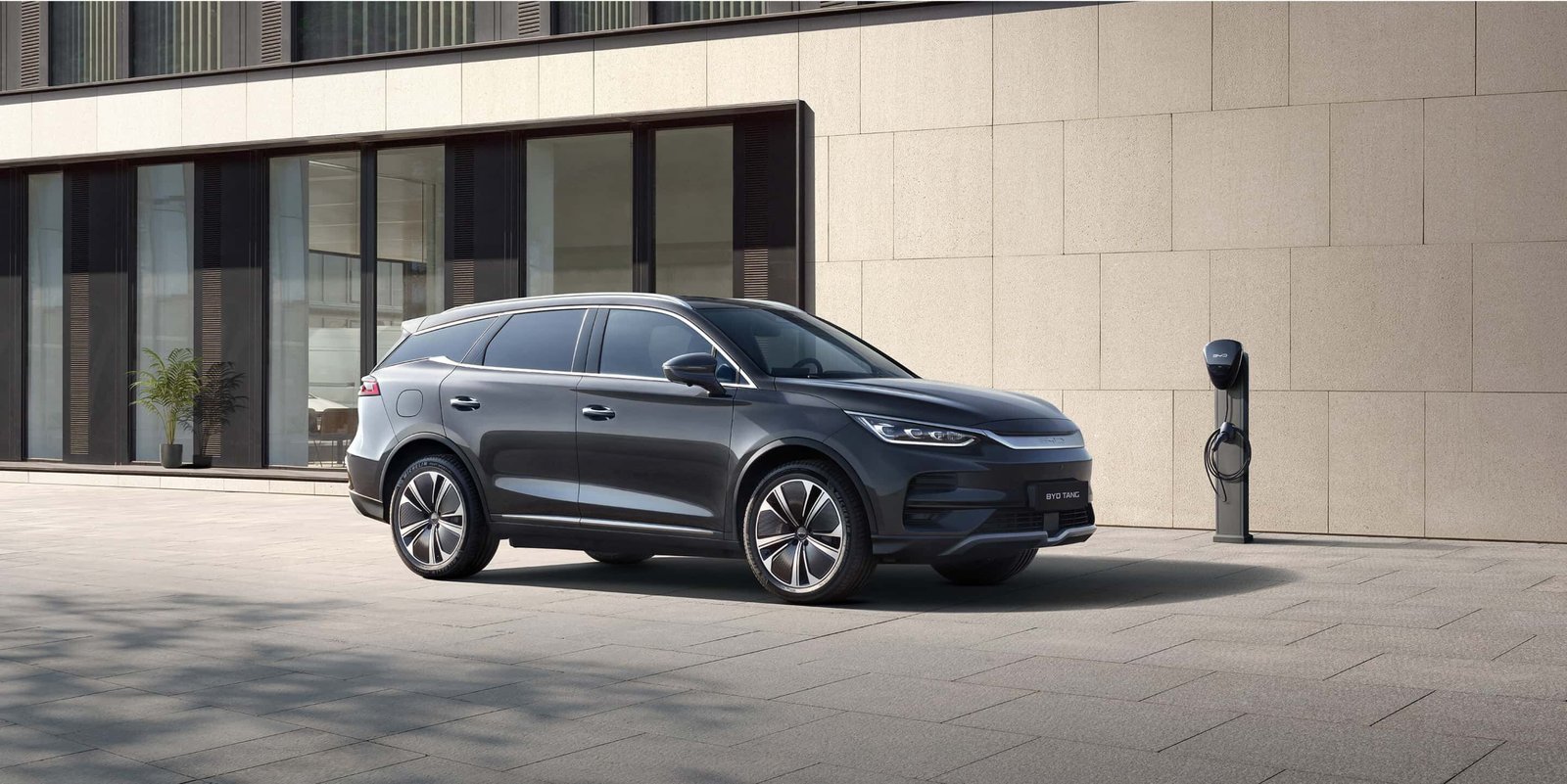
| TANG | 90 kWh | 50 min | 600 km |
| T5 DM-i | 18.3 kWh | 10 min | 1138 km |
T5 DM-i is a plug-in hybrid: 1138 km is its combined range on a full battery and a full tank. Fast-charging times are for DC charging over a partial window, not 0-100%, and depend on the charger. Range depends on driving style, speed, temperature and route.
Questions
What buyers ask first
Can I charge from a normal socket at home?
Yes, from a standard domestic socket. It is the slowest option, so for regular home charging a wall-mounted charger is worth installing: it is up to three times faster.
How long will the battery last?
It is rated at more than 5,000 charge and discharge cycles, several times the 1,000-2,000 typical of NCM batteries, and BYD puts its working life at over ten years. LFP degrades slowly rather than dropping away after a few years.
What happens in winter?
Range falls in the cold in most electric cars, largely because of the heater. BYD fits a heat pump that recovers heat from the surroundings, the powertrain and the battery itself. In the Norwegian Automobile Federation winter test, the BYD TANG lost the least range against its stated figure.
Does fast charging harm the battery?
Fast charging is what the DC port is for: the battery management system controls current and temperature, and direct heating and cooling holds the pack in its working range.
What is the difference between an electric car and a DM-i hybrid?
A battery electric vehicle runs only on its battery and motor, with no engine and no exhaust emissions. A plug-in hybrid (DM-i) has both: it drives on electricity until the battery is low, then the engine takes over, so a long trip needs no charging stop.
Do I have to charge a DM-i hybrid every day?
No. Charging gives the biggest savings, since you then drive electric most of the time. But unlike a typical plug-in hybrid, a DM-i stays efficient even when rarely charged: the motor still does most of the driving.
Chargers, cables and adapters
Accessories

Book a test drive
Two fields — your name and number. We take it from there: we call you back and agree a time.